
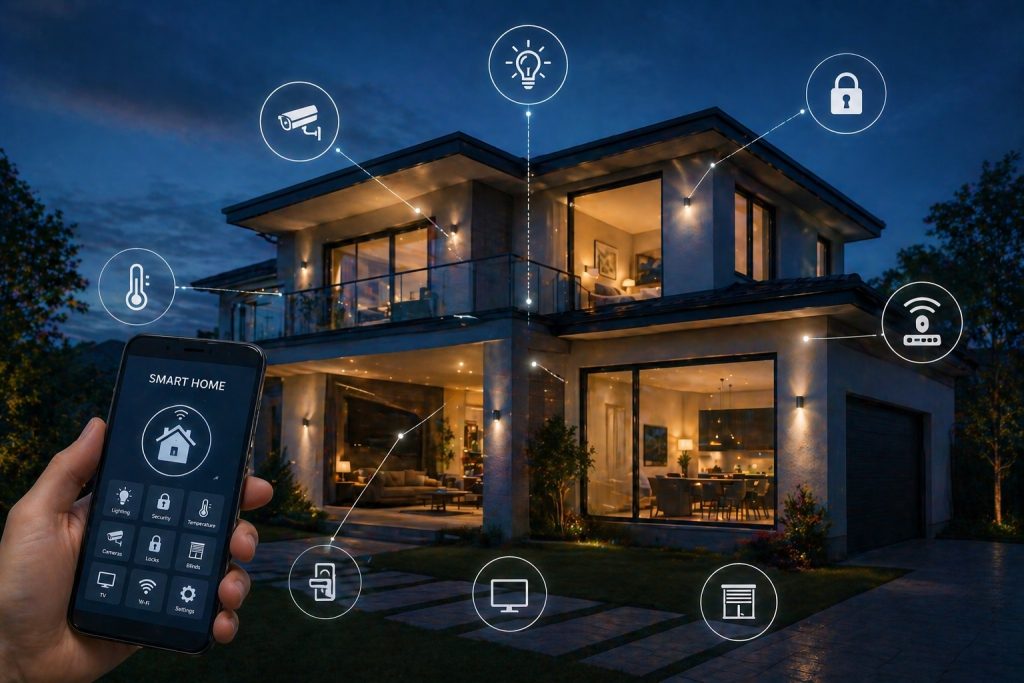
A smart home is a modern living space equipped with advanced technology that allows homeowners to control and automate various household functions. From lighting and temperature to security and entertainment, smart homes provide convenience, efficiency, and enhanced control. At the core of a smart home are connected devices that communicate with each other through the internet. These devices can be controlled remotely using smartphones, tablets, or voice assistants. This means you can manage your home even when you are not physically present.
Smart home systems typically include devices such as smart lights, thermostats, security cameras, door locks, motion sensors, and home appliances. These devices are connected through a central hub or a mobile app, allowing seamless integration and control. One of the key features of a smart home is automation. For example, you can set your lights to turn on automatically when you enter a room or schedule your air conditioning to start before you arrive home. Automation not only improves comfort but also helps in saving energy.
Security is another major advantage of smart homes. With smart cameras, motion detectors, and alarm systems, homeowners can monitor their property in real time. Notifications can be sent directly to your phone if any unusual activity is detected, providing peace of mind.
Energy efficiency is a significant benefit of smart home technology. Devices such as smart thermostats and lighting systems optimize energy usage by operating only when needed. This helps reduce electricity consumption and lowers utility bills.
Smart homes also enhance convenience. Voice assistants allow you to control devices with simple commands. For instance, you can turn off lights, adjust temperature, or lock doors without moving from your place.
The technology behind smart homes relies on the Internet of Things (IoT), where devices are interconnected and share data. This connectivity allows systems to learn user preferences over time and operate more efficiently.
Installation of a smart home system can be customized according to your needs. Whether you want basic automation or a fully integrated system, solutions can be tailored for every budget.
In conclusion, a smart home uses connected technology to automate and control household functions. It improves convenience, security, and energy efficiency, making it an essential part of modern living. As technology continues to evolve, smart homes are becoming more accessible and increasingly popular.