
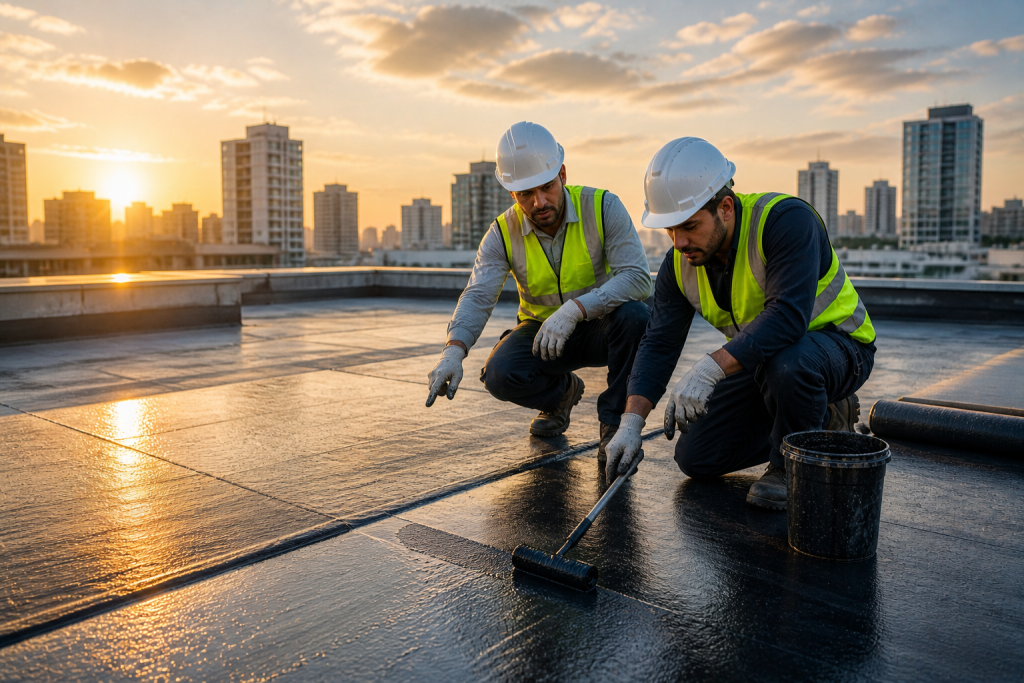
Protecting Structural Integrity & Long-Term Strength
Alvi Builders | Building the future where innovation meets Sustainability
What is Waterproofing?
Definition
Waterproofing is the process of making a structure resistant to the ingress of water — under hydrostatic conditions or through surface contact — to protect the building’s fabric, reinforcement, and occupants.
Barrier System
Membranes, coatings, and sealants form a continuous barrier preventing moisture from penetrating walls, roofs, and foundations.
Drainage Integration
Effective waterproofing pairs with drainage layers to redirect water away from the structure safely.
Preservation Layer
Acts as the first line of defence for concrete, steel reinforcement, and finishes against moisture-driven decay.
Why Waterproofing is Critical
Reinforcement Corrosion
Moisture penetrates concrete and reaches steel rebar, triggering rust. Rust expands, cracking the concrete cover — a process called spalling — which dramatically reduces load-bearing capacity.
Foundation Settlement
Waterlogged sub-soils lose bearing capacity. Uneven settlement causes cracks, tilting, and structural distortion — costly and sometimes irreversible.
Concrete Carbonation
Water carries CO₂ deep into concrete, lowering its alkalinity and neutralizing the protective chemistry around steel. Accelerated in humid climates like Lahore’s monsoon season.
Mold, Efflorescence & Decay
Damp environments breed mold, mildew, and salt deposits. These degrade finishes, insulation, and timber elements, reducing the building’s lifespan and indoor air quality.
Lahore’s Environment & Climate
47°C
Peak Summer
Temperature
200mm+
Avg. Monsoon
Rainfall / Month
80%+
Humidity During
Monsoon Season
Extreme Thermal Cycling
Lahore’s temperatures swing from near-freezing winters to 45–47°C summers. This repeated expansion and contraction of concrete opens micro-cracks that allow moisture ingress.
Intense Monsoon Season
July–September brings torrential rains, driving water against walls and into poorly sealed joints. Standing water around foundations is common in undraining plots.
High Ambient Humidity
Even outside monsoon, humidity levels promote condensation inside walls, accelerating corrosion of embedded steel and degrading mortar bonds.
Lahore’s Soil Conditions
Fill / Topsoil
0–1.5 m
Fill / Topsoil
0–1.5 m
Fill / Topsoil
0–1.5 m
Fill / Topsoil
0–1.5 m
Variable, often disturbed
High shrink-swell potential
Better bearing capacity
Groundwater table zone
High Water Table
Lahore’s water table can rise to within 1–2 m of the surface during monsoons, creating upward hydrostatic pressure on basements and slabs.
Expansive Clays
The alluvial clay belt shrinks in dry summers and swells when wet, exerting enormous lateral and vertical pressure on foundations and retaining walls.
Salt Content (Sulphates)
Naturally occurring sulphates in Lahore’s soil react with ordinary Portland cement, causing concrete to expand and crack — requiring sulphate-resistant mixes and protective membranes.
Variable Permeability
Sandy pockets within the silt profile allow rapid water movement, requiring cut-off walls and tanking systems around basements to prevent seepage.
Waterproofing Methods & Systems
Cementitious Coatings
USE: Roofs, wet areas
Rigid cement-based slurries applied directly to concrete. Excellent for above-grade areas. Easy to apply, cost-effective for Lahore’s budget-conscious market.
Bituminous Membranes
USE: Foundations, basements
Torch-applied or self-adhesive bitumen sheets. Superior performance under hydrostatic pressure — ideal for Lahore’s high water table zones.
Liquid-Applied Membranes
USE: Complex shapes, balconies
Seamless polyurethane or acrylic coatings that cure to a flexible film. Critical for Lahore rooftops that experience thermal shock daily.
Crystalline Waterproofing
USE: Concrete structures
Penetrates concrete and reacts with moisture to form crystals, permanently sealing micro-cracks. Self-healing properties ideal for Lahore’s expansive clay soils.
Drainage Board Systems
USE: Retaining walls, basements
Dimpled HDPE boards channel groundwater away from the structure before it can build hydrostatic pressure.
Injection Grouting
USE: Remedial / repair
Polyurethane or epoxy injected into active cracks to stop leaks immediately — essential in older Lahore buildings.
Consequences of Poor Waterproofing
Year 1–3
Surface Staining & Efflorescence
White salt deposits, damp patches, and peeling paint appear. Occupants dismiss these as cosmetic — they are early warnings.
Year 3–8
Rebar Corrosion Begins
Moisture reaches embedded steel. Rust products (3× volume of steel) build internal pressure. Hairline cracks appear in concrete.
Year 8–15
Concrete Spalling & Structural Cracks
Chunks of concrete fall from soffits and walls. Cracks widen. Structural capacity is measurably reduced.
Year 15+
Structural Failure Risk
Load paths compromised. In extreme cases, partial or total collapse. Remediation costs 10–20× the original waterproofing cost.
01 Start with Site Investigation
Conduct soil testing to determine water table depth, sulphate content, and bearing capacity before choosing a waterproofing system.
02 Use Sulphate-Resistant Cement
Lahore’s sulphate-rich soil demands SR cement (SRPC / OPC with additives) as a baseline — not an upgrade.
03 Design for Hydrostatic Pressure
Basements in Lahore must be tanked from the outside (positive side) to resist the full monsoon water table pressure.
04 Treat All Transitions & Joints
Wall-slab junctions, pipe penetrations, and expansion joints are the most common failure points. Specify waterstops and flexible sealants.
05 Specify Roof Drainage Correctly
Flat roofs must slope ≥ 1:50. Blocked drains cause ponding — waterproof membranes are not designed for permanent immersion.
06 Quality Control During Installation
Even premium materials fail if poorly applied. Independent inspection at wet-area stages protects your investment.